Pilleri OF THE CHILEAN. OUR DISHONESTY UNREPORTED
Mauricio Castro Pedrero
Public Administrator March 2006

Who has reacted angrily to read newspapers or watch on television, news related to corruption in politics?. Many mayors, parliamentarians, government officials - among others - are constantly accused of having participated in an act ethically reprehensible. Some charges are based on indisputable facts (some legal, but not so with respect for the principle of probity) and others - let's be fair - they are simply "flying light" to bring political dividends. But let me ask a question: does the act dishonestly - which is what a corrupt act implies - is a behavior rooted only in politics or covers to society as a whole?. I fear that the second option is the closest to reality. In short, corruption known to the public, are a true reflection of what society is. So - and as you already must have guessed - it must be recognized first of all, that to curb corruption, we must begin to act honestly in our daily life.
In this regard, it is a mistake to focus the problem only for people who hold positions in the state apparatus, even though the best known by the public through the media - which have an important influence on public opinion - are related to these officials.
In the private sector, there are some examples of what I'm proposing. I'll make the next year. Anytime you see in the newspaper an "errata" of any multi-shop, look for the "error" - usually on prices - is beneficial or detrimental to the potential consumer. The most likely - and I've been watching for a long time - is that the error will not be pleased at all the customer in almost all cases. What is this?. For some, this represents faithfully the "mischief of the Chilean" as a person "shrewd and insightful" realized that there was a legal vacuum and, using the errata, sales could be improved (this vivacity is justified in that is not acting outside the law). For others however - including myself certainly included - this act reveals a dishonest behavior that unfortunately is increasingly institutionalized in our society.
However, it is likely that the preceding example is seen by you as something far away. But let us approach a little closer to our everyday reality. Who does not ever been observed, a row in the bank?, who has not resorted to a close, to get a job?, who has preferred to keep silent when they are wrong in a restaurant in your account and get paid less than it should ?, who has not even thought of getting a medical license to a doctor friend in circumstances that justify the receipt of such benefit?. I could go on with many examples. All these facts show very little honest behavior. Unfortunately, Chilean society seems not to punish this act. Moreover, these facts seem to be deeply entrenched in our national identity and no signs that this will change in the near future.
A recent study conducted by the MORI polling [1] to the Chilean Chapter of Transparency International - Corporación Chile Transparente - shows that the sin is recognized by the Chilean respondents is pretend to be sick to go work (37% said they know or have heard of someone who has engaged in this practice), 24% admitted having hidden products in the supermarket for not paying in cash, 19% said that managed to pay less tax and, 11% recognized benefit of a subsidy that did not belong.
These facts are known as social fraud, meaning concept to those behaviors that "have no legal or social sanction, but are in the dark side of collective morality, violating rules that no one controls properly applied" [2] . This phenomenon arises from a sense of inequality of opportunities, injustice regarding access to certain goods or services they demand in different areas of our lives. From this sense, then comes the justification for these dishonest, which is based primarily on the premise that "everybody does it ... why I do not? ". This time, a behavior that arises from a sense of inequality, and that manifests itself in breaking some rules.
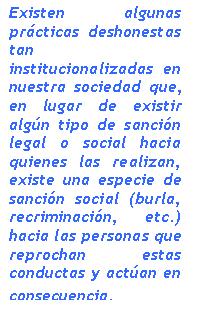
surprising thing at this point is that there are some dishonest practices as institutionalized in our society, rather than be some kind of legal or social sanction to those who make them, there is a kind of social sanction (mockery, recrimination, etc. ) to those who criticize these behaviors and act accordingly. In other words, those who are involved in an activity described here as social fraud, flaunt their "resiliency." By contrast, people who seek to act with honesty is perceived - to put it in some way - as "too innocent."
A paradigm of this, is the star of the Chilean film "King of Fools" will soon be released in our country. In this film, the protagonist - a taxi driver named Anselmo - found a bag with 24 million dollars and, instead of keeping the money, decides to return to the police. And what do you think your friends and / or near applauded and congratulated for showing such degree of righteousness?. No, quite the contrary!. This was enough to be named herself as the "king of the idiots."
I will not deny it's funny (in the context of a comedy). It's good and healthy laugh at ourselves. However, the situation described in the preceding paragraph fully represents our character, in which the moral seems to be that this world is made for the "rogues", the "lively."
social fraud is a phenomenon that rarely pay attention, but it is a scourge that we must not neglect. Especially because it makes us think about ourselves. In reflecting on this issue, we fail to see corruption as a problem of others - politicians, the powerful - but we see it as a problem that crosses the whole society, which we are part.
is clear that corruption and the dishonest act is more concentrated in the areas of power (political, economic, religious, etc.), But it is a fact that in many areas of daily life are also rooted dishonest - referred to in this article as a social fraud - that go unnoticed by many when talking or writing about corruption and ethics. And - at least I - I have the impression that start navel-gazing from time to time is a good exercise if you really want things to change ... do not you think?.
[2] Ibid.


0 comments:
Post a Comment